Roger Deakins' Cinematography Style: Light, Restraint, and the 40-Year Wait
Fourteen Oscar nominations, one stubborn idea about light, and why subtracting almost always reads as more on screen.

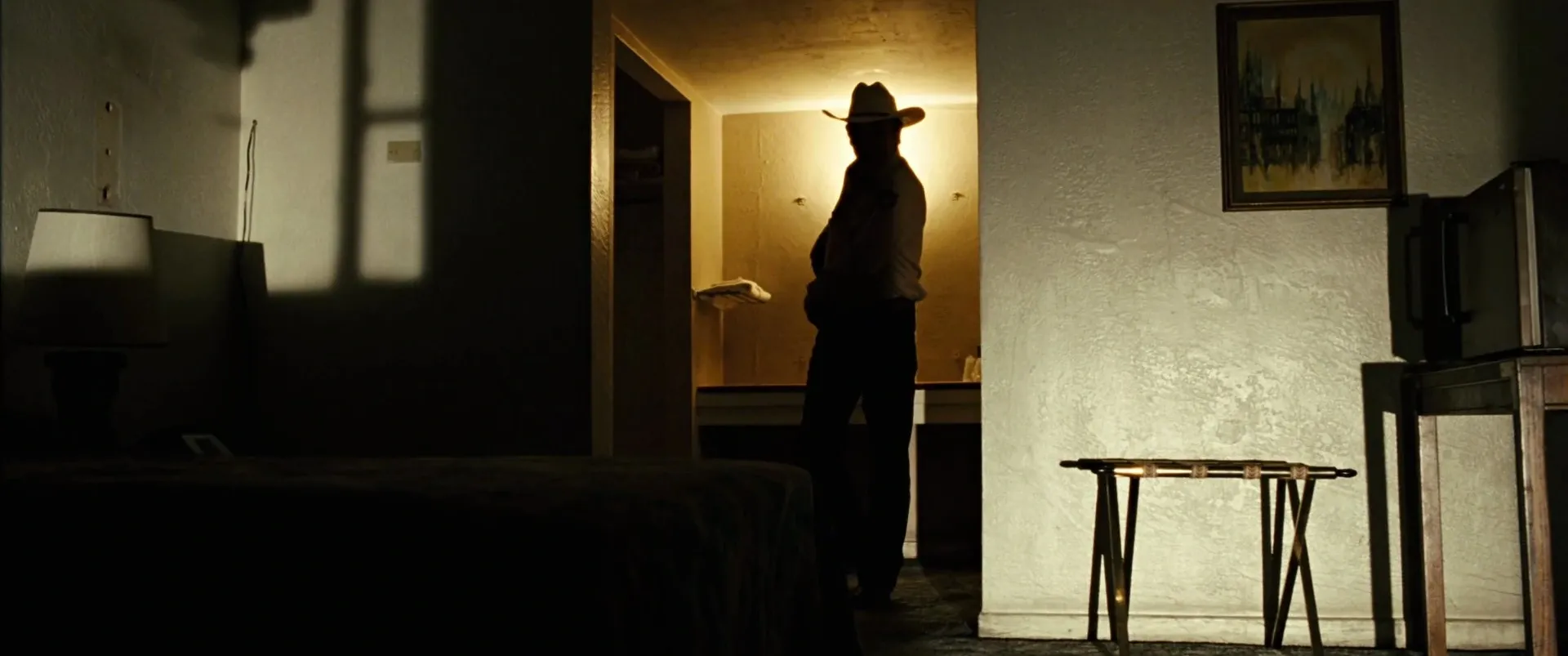
There's a shot early in No Country for Old Men where a man in a cowboy hat stands in a motel doorway, half-swallowed by shadow, lit by a single warm bulb bleeding out of the room behind him. You can't read his face. You don't need to. That frame tells you everything about the Roger Deakins cinematography style: one source, a lot of darkness, and complete confidence that the audience will lean in rather than complain they can't see.
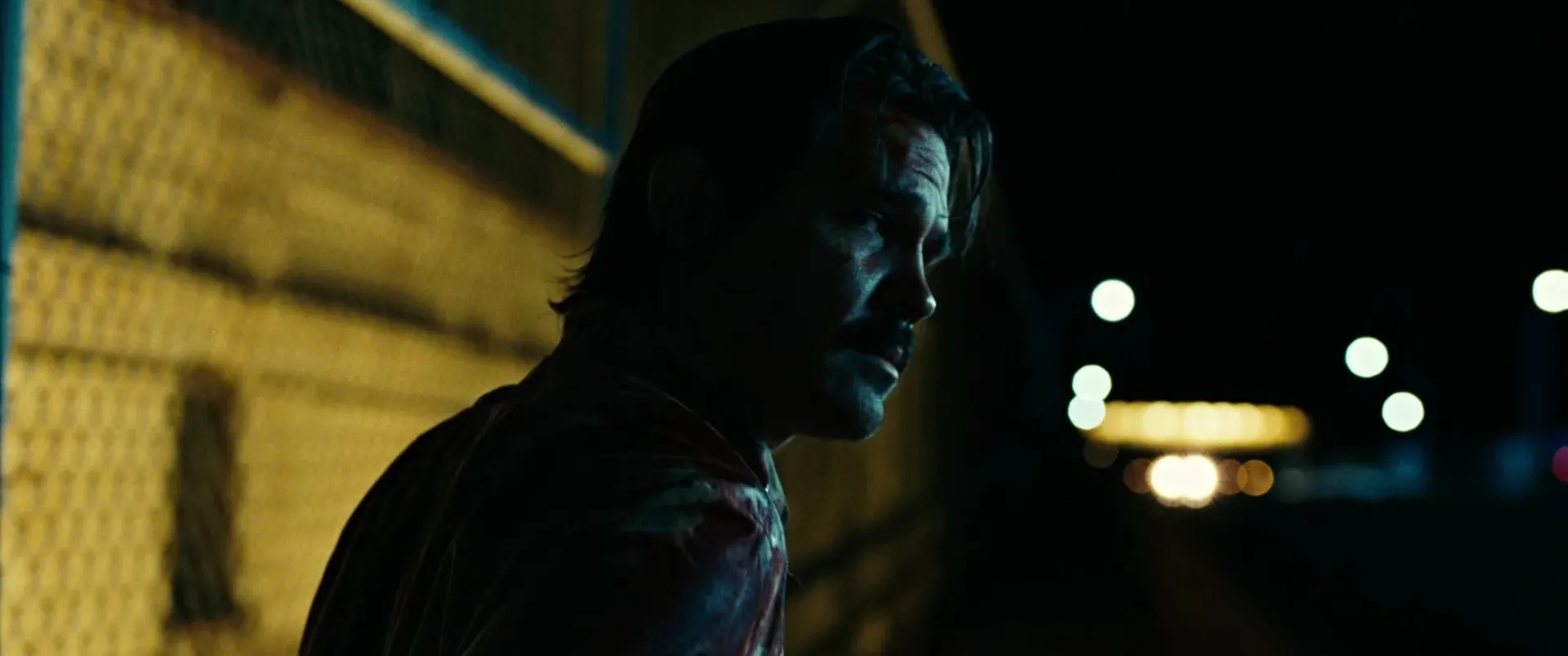
Deakins won his first Academy Award for Blade Runner 2049 in 2018 — his fourteenth nomination, after decades of shooting since the 1970s. He won a second two years later for 1917. The overnight success took about forty years. What's worth studying isn't the wait, though. It's how consistent the work stayed across it. Watch a Deakins film from any decade and the same instincts show up.
The core of the Roger Deakins cinematography style: subtract, don't add
Most lighting problems get solved by adding. Another unit, another bounce, a little fill to lift the shadows, a kicker to separate the actor from the background. Deakins tends to go the other way. His reputation is built on soft, motivated sources — often one — and a willingness to let the rest of the frame fall off into black.
He's been open about how mechanical this can get. His go-to interior trick is a "cove": a length of unbleached muslin wrapped around part of the set, hit with small tungsten units, giving him a soft wash that reads as ambient room light rather than a lamp someone aimed at the actor. The muslin warms the skin. The softness hides the rig. You never catch the light working.
That's the whole point. Deakins has said he doesn't want you to notice the lighting — it should feel like it simply belongs there. When a technique disappears that completely, it stops being technique and becomes the look of the film.
Negative fill: the nerve to let faces go dark
The flashier half of that philosophy is negative fill — actively taking light away. Where most setups fight shadow, Deakins shapes it, flagging off the ambient bounce so one side of a face drops into near-black.
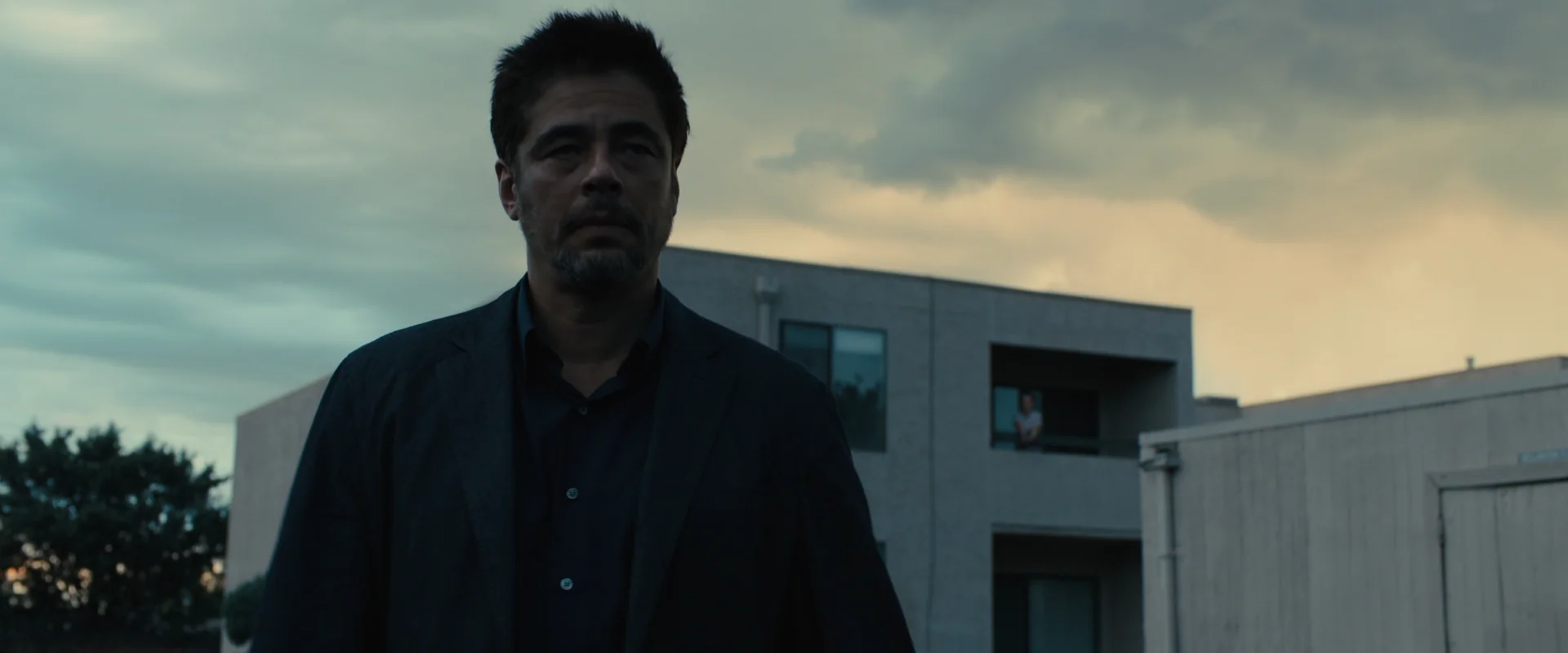
Look at Sicario. Villeneuve's cartel thriller lives in low light, and Deakins never panics about it. Faces sit in half-shadow. Figures go to silhouette against a bruised dusk sky. The famous border-raid sequence pushes it to the limit — he shot the assault through the characters' own night-vision and FLIR thermal cameras, using a single 1000-watt source hung on a crane a couple hundred feet off just to lift a faint edge out of the dark. The result feels almost documentary, like you're watching something you weren't cleared to see.
The lesson for anyone lighting a scene: contrast is a choice, not an accident. Deciding what not to light is as expressive as deciding what to light. A frame that keeps its shadows honest carries more tension than one lit evenly so nothing gets missed.
The landscape as a character
Deakins came up shooting documentaries, and it shows in how he handles exteriors. He doesn't prettify a location so much as respect it. His West Texas in No Country is flat, hazy, sun-bleached, and enormous — a place indifferent to the people crossing it.
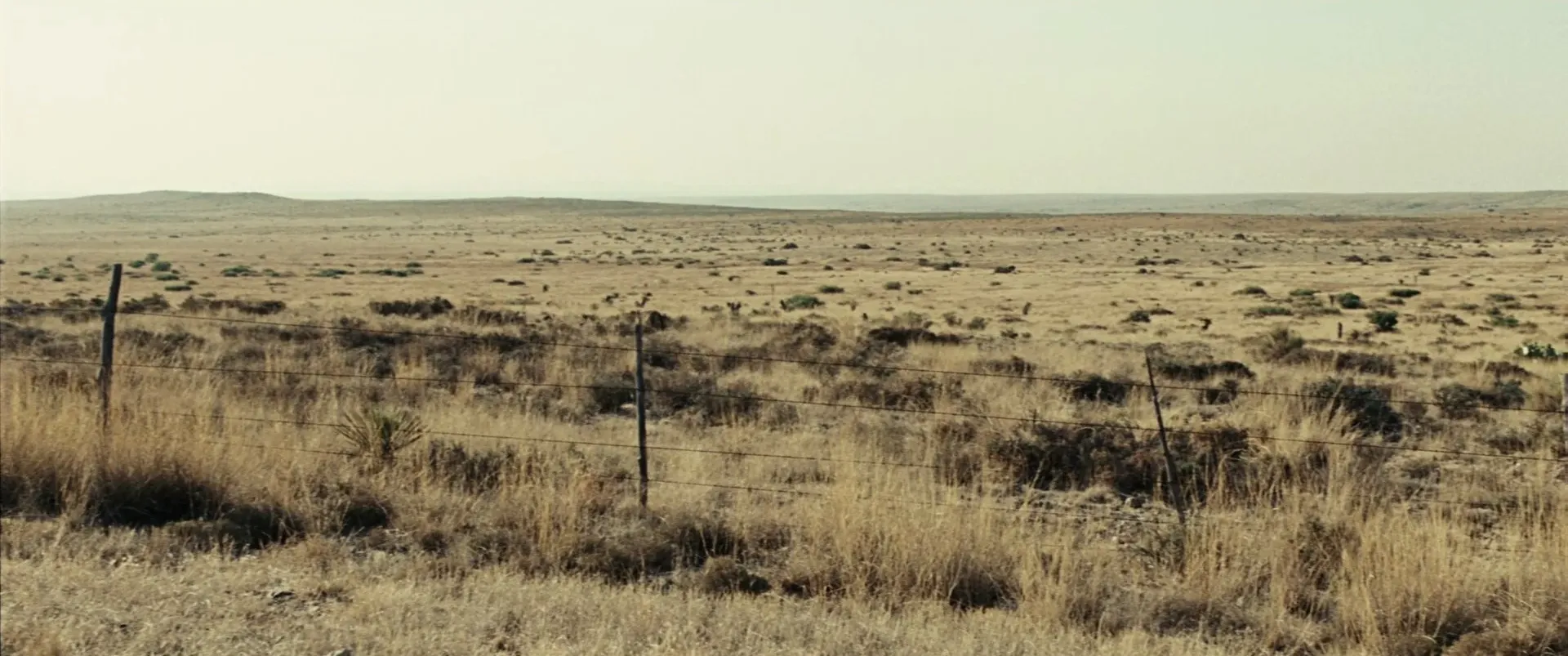
There's no drama forced onto this frame. Flat light, a plain horizon, a barbed-wire line running off into nothing. It works because the restraint matches the story — the emptiness is the threat. That's the naturalistic streak in the Roger Deakins cinematography style: find the frame the location already gives you, and trust it to carry weight without a filter stack or a sky replacement.
It's the same discipline as the interiors, pointed outward. Don't decorate. Observe, then compose so the observation lands.
What you can actually take from it
You're not going to hire Deakins, and you probably don't have his crew or his time. That's fine — the ideas travel further than the budget.
- Start with one source and a reason for it. Where is the light in the world of the scene coming from? Motivate that, and resist adding a second unit until the frame genuinely fails.
- Try negative fill before more fill. A flag that kills a bounce often does more for a face than another light ever would.
- Let the location speak. Before you dress and relight an exterior, shoot the frame it already hands you.
None of this reads on the page. It reads when you can look at a reference and a plan side by side and see whether the light in your head actually holds up. Pulling frames from films that already solved the problem — a single-source interior, a silhouette against a bright sky, a flat naturalistic exterior — turns a vague intention into something your gaffer and director can look at together. That's exactly the gap a proper visual reference library closes, and why so many DPs use movie stills as lighting reference on set rather than trying to describe a look in words.
Deakins spent forty years proving that restraint reads as confidence. Steal the instinct, not just the frames.
How did you like this article?
Login to react to this article
Discussion (0)
💬 No comments yet. Be the first to share your thoughts!